
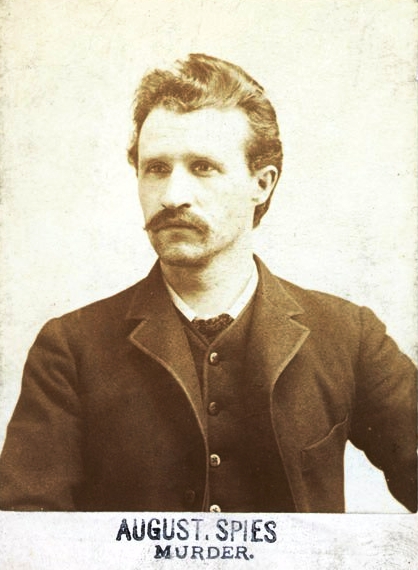
With a name like that, how can you not do big things? At first, I thought August Spies was not one person, but a network of Anarchists in Chicago.
Now, I don’t claim August to be a punk just because he was an anarchist. Anarchism is a political ideology and not just a symbol you can find plastered all over Spencer’s and Hot Topics across the country. He’s a punk because he was aggressive, and challenged the status quo. Today, he’d probably be tweeting “Eat the Rich,” and would have absolutely loved the new Joker movie.
Born to a middle-class family in Germany in 1855, Spies remembered his childhood as one of relative privilege. But the unexpected death of his father and the loss of financial security led August and his mother to seek a new life in America. Had his father not died, August might not have ever started working with international labor activists and would have likely continued to be comforted by a life of middle-class ease Germany.
Spies found work as an upholsterer and became increasingly involved in labor politics, initially joining the Socialist Labor Party in 1877. He was increasingly radicalized and split from the group. The newspaper Spies edited, the German-language Arbeiter-Zeitung, was similarly dropped by the Socialist Labor Party. None of this deterred Spies, and he continued his work towards labor reform. He became known for his aggressive speeches that incited violence. One quote in particular:
“We urgently call upon the wage-class to arm itself in order to be able to put forth against the exploiters such an argument which alone can be effective – violence.”
So, yeah, pretty cut and dry there. His activities came to a head on May 3, 1886 at the McCormick Harvesting Machine Plant.
To understand why that date is important, I need to take you back a couple of years. In October of 1884, it was decided by the Federation of Organized Trades and Labor Unions that May 1, 1886, would be the date by which the 8-hour workday would be the standard. Today, even the 5-day 8-hour workweek is debated and despised by some, myself included. But in the 19th-century, laborers were working 60 hour weeks over six day work weeks, with little to no safety standards or protections for workers. Labor Unions demanded eight hours work, eight hours rest, and eight hours of play. It seemed simple enough. As the anticipated date approached, labor unions across the country organized strikes. Strikebreakers, non-unionized workers who factories called into work when unions were striking, picked up the work and kept factories running. Strikebreakers were sometimes referred to as the unaffectionate nickname “scabs.”
On the third day of the strike, workers met at the McCormick Harvesting Machine Plant. Spies famously stated: “Stand by your Union, or you will not succeed.” When the strikebreakers left the factory at the end of the day, many of the strikers confronted them, animosity and tensions flared. Police showed up, fired randomly into the crowd, and killed two of the scabs. The anarchists quickly organized another demonstration for the next day in Haymarket Square.
Some 3,000 workers initially showed up, although reports indicate the crowds dwindled to a few hundred as the morning wore on. Around 10 AM, 180 police officers arrived, advising demonstrators to disperse. A bomb was thrown, which incited police to open fire once again. Ultimately, eight men were killed in the explosion, but the official number killed after the police retaliation is unknown. Over two hundred were injured.
In the following days, eight Anarchist suspects were indicted for murder, Spies among them. A significant piece of evidence against Spies came from Gottfried Waller, who testified that the word “Ruhe” would appear in the Arbeiter-Zeitung should the Anarchists need to be called to arms. It was indeed published the morning of May 4, supposedly in Spies’ handwriting. All eight were convicted. Three were sentenced to life in prison, and the other five were sentenced to the gallows. One Anarchist, Louis Lingg, committed suicide. The remaining four (Spies, Albert Parsons, Adolph Fischer, and George Engels,) were walked to the platform. Spies’ last words?
“There will be a time when our silence will be more powerful than the voices you strangle today.”
Had he not left Germany, or had his father not died, August Spies might have ended up in a completely different circumstance. Would he have ever been aware of the plight of the average industrial worker, or the serious reforms needed in labor, or the value of the Union? It is hard to say. He committed himself to the ideals of socialism and labor reform at a tender age when one starts to become aware of the workings of the world around them.
There you have it: August Spies; anarchist, an enemy of the rich, a Great Punk in History (and probably a great punk band name, too).
 Punk Prana
1 Comment